
Reflections from Deaf Awareness Day at Hi Hopes. Written by Alia Booley and Natasha Van Staden
ION South Africa
What happens when we judge human communication through senses that not everyone shares?
Imagine a child who does not look into another person’s eyes. Another who does not respond when their name is called. And another who communicates through movement, touch, patterns, signs, or behaviours that others may struggle to interpret.
What do we conclude about these children?
Our conclusions may tell us as much about the expectations of the observer as they do about the child.
Beyond the “neat box”
For generations, human development has been studied and assessed through frameworks that assume particular ways of seeing, hearing, communicating, learning, and interacting.
But human beings do not all access or process the world in the same way. Difference is part of human life, not evidence that one person is less capable than another.
A Deaf person may communicate through sign language. A blind person may navigate through sound, touch, and spatial information. An autistic person may process sensory and social information differently. Some people may experience several of these variations simultaneously.
Are we measuring a person’s abilities, or their ability to demonstrate those abilities through our preferred methods?
Different ways of communicating and being
Deafness, blindness, DeafBlindness, and neuro-developmental variations are distinct, and they should not be conflated. At the same time, an unfamiliar response should not be mistaken for a lack of understanding, intelligence, connection, or capacity.
Accessibility and communication differences matter. They shape what others are able to notice, understand, and respond to, while also reminding us that no single environment can erase every barrier or make every experience the same.
Creating access is part of the ongoing work of respecting difference, removing exclusion, and meeting people as they are.
Listening with HiHopes
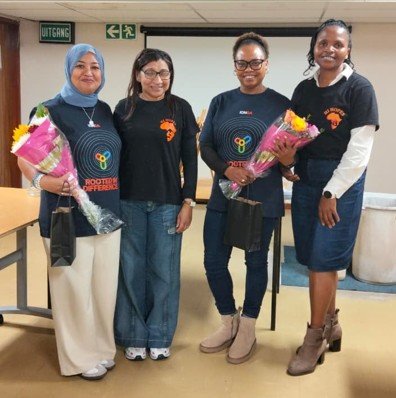
ION South Africa had the privilege of being invited back for a second time to speak at Hi Hopes, an organisation supporting families of deaf and partially deaf children. We joined them on Deaf Awareness Day to share our lived experiences of neurodiversity and neurodivergence.
The Hi Hopes home interventionists were eager to explore what neurodiversity means in everyday life. Together, we talked about overlapping traits they may recognise in the children they support, as well as in themselves, their partners, their families, and their wider communities.
Sharing lived experience can reduce fear, build understanding, and invite compassion. It helps us move beyond assumptions and make room for more honest ways of connecting.
When systems leave families waiting
The realities shared at Hi Hopes connect to a wider systemic challenge: schools are often not equipped to support children who do not fit narrow expectations of communication, behaviour, learning, or participation.
Mainstream schools may turn children away, while specialised schools can be unaffordable or already full. Children are left on waiting lists, and families are left in limbo without the support they need.
This is not a measure of a parent’s commitment. Families are often doing the best they can with what they have, while carrying the weight of judgement for gaps created by systems.
Many parents cannot afford to stay at home while waiting for support or a suitable school placement. The rising cost of living adds further pressure, and homeschooling is not a viable option for every family, especially when parents need to work or resources are limited. This is particularly important to recognise for single parents and grandparents raising their grandchildren, who may already be carrying significant caregiving, financial, and practical responsibilities.
How can we build better systems that support families and communities in real life? Inclusion cannot depend on one parent, one grandparent, or one household carrying everything. Families need accessible schools, responsive support, affordable care, community networks, reasonable flexibility, and systems that recognise different family structures.
“A waiting list is not support. Children shouldn’t have to wait for the system to catch up just to have a place where they belong.”
Making room from the beginning
Thank you to HiHopes and the wonderful team for opening the room to this conversation. We are always grateful to be part of spaces where awareness, practical tools, strategies, community, and genuine understanding come together.
Real change begins when we stop asking children to fit into rigid boxes and start questioning whether our definitions of communication, intelligence, learning, and belonging are inclusive enough.
Communities, schools, healthcare, research, and support systems must make room for human variation from the beginning, not treat it as an exception.
To learn more about Hi Hopes or connect with the organisation, visit their website: https://www.hihopes.co.za/meet-the-team/