
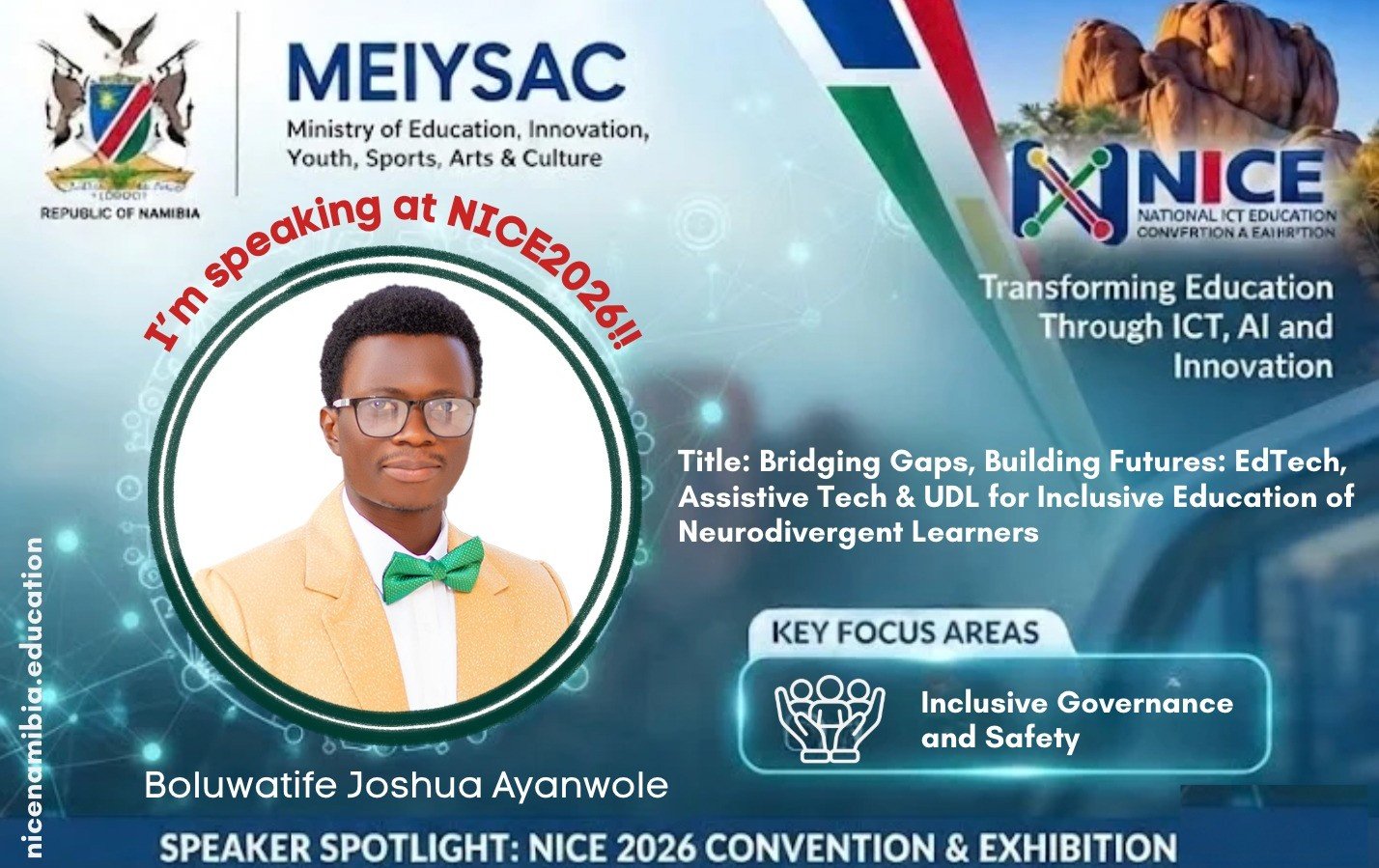
Renowned Neurodiversity Advocate and SEN Expert, Ayanwole Boluwatife Joshua Speaks at NICE 2026 in Namibia, Champions Inclusion Through EdTech
ION U35 versatile African Inclusion Leader Presents on Bridging Gaps with Assistive Technology and UDL for Neurodivergent Learners at National ICT in Education Convention
OTJIWARONGO, Namibia – 5-9 October 2026 —
Renowned Neurodiversity Advocate and Special Educational Needs (SEN) Expert, Ayanwole Boluwatife Joshua, FIFIP, OSHP, HSEP, AICSP, delivered a landmark presentation online at the National ICT in Education Convention & Exhibition (NICE 2026) in Otjiwarongo, Otjozondjupa Region, Namibia.
Boluwatife Joshua, who is the Institute of Neurodiversity (ION) Global Youth Ambassador and recognized as one of Africa’s leading voices on inclusion, presented alongside co-presenter Eyvonne Eleko, Accessibility Strategist and Inclusive Technology Speaker, Founder of DOE.
The presentation, themed “Bridging Gaps, Building Futures: EdTech, Assistive Technology & UDL for Inclusive Education of Neurodivergent Learners” under the track Inclusive Education through EdTech, addressed one of the most pressing questions in African education today: Who gets to participate, and what makes participation meaningful?
Speaking to distinguished organizers, educators, policymakers, parents, and advocates, Joshua stated: “Namibia has already made the commitment to education for every learner. The work now is turning that commitment into participation, lesson by lesson. A learner can attend a lesson and still encounter barriers to understanding instructions, accessing information, or demonstrating knowledge.”
Drawing on his extensive work in neurodiversity-affirming practice, inclusive education, behaviour and learning support, and early identification and intervention, Joshua highlighted the journey of Namibia’s inclusive education — from Article 20 of the 1990 Constitution, to the ratification of the UN Convention on the Rights of Persons with Disabilities in 2007, to the 2013 Sector Policy on Inclusive Education.
In his session, Joshua broke down practical strategies for the classroom:
Understanding Neurodivergent Learners: Joshua explicitly shed light on autism and other neurodivergent conditions, explaining their signs, strengths, and support needs. He emphasized the need for society, teachers, parents, and every stakeholder to shift perspective — to see strength instead of deficits or limitations. He noted that learners with the same diagnosis may require different supports and that effective support must begin with observation, learner feedback, and collaboration with families and specialists.
Identifying Barriers Within the Task: He demonstrated how a single lesson — like the water-cycle — can present multiple barriers in reading, following instructions, writing, and environmental demands, and how support must address the specific barrier while preserving the learning goal.
Universal Design for Learning (UDL) and Assistive Technology: Presenting alongside Eyvonne Eleko, Eyvonne unpacked how UDL principles of Engagement, Representation, and Action & Expression, combined with assistive technologies like text-to-speech, visual schedules, speech-to-text, and Augmentative and Alternative Communication (AAC), can transform access.
Choosing Technology That Fits: They provided a 6-point framework for schools: Purpose, Usability, Language, Availability, Sustainability, and Privacy — urging schools to verify costs, offline capabilities and language support before adoption.
AI for Teacher Preparation: He showcased a bounded, ethical use of AI to draft clearer instructions and glossaries while insisting that teachers must always review for scientific accuracy, curriculum alignment and accessibility.
Implementation for Namibia: He proposed priorities tailored to Namibia — language inclusivity, infrastructure realities, teacher capacity, affordability, and collaboration with learners and families — building on existing resources such as the Ministry of Education’s Practical Guide to inclusive practices.
The session concluded with a call to action: moving from mere access to meaningful participation, where teachers examine one lesson for barriers, school leaders provide time and resources, and technology providers test solutions with intended users.
NICE 2026, themed “Transforming Education through ICT, AI and Innovation for an Inclusive Digital Namibia,” brought together stakeholders from across Africa to shape the future of inclusive digital learning.
Appreciation
Ayanwole Boluwatife Joshua expresses his profound gratitude to the organizers of the National ICT in Education Convention & Exhibition (NICE 2026) and to the Republic of Namibia for the honour and invitation to address inclusion and EduTech in Africa. He extends special thanks to Dr. Heidi Cavanagh for her leadership and support.
“I remain deeply committed to challenging stigma in Africa and supporting inclusion until exclusion is gone,” Joshua affirmed. Ayanwole Boluwatife Joshua continues to lead cross-continental initiatives that dismantle stigma and advance inclusion for neurominorities and People of Determination globally.