
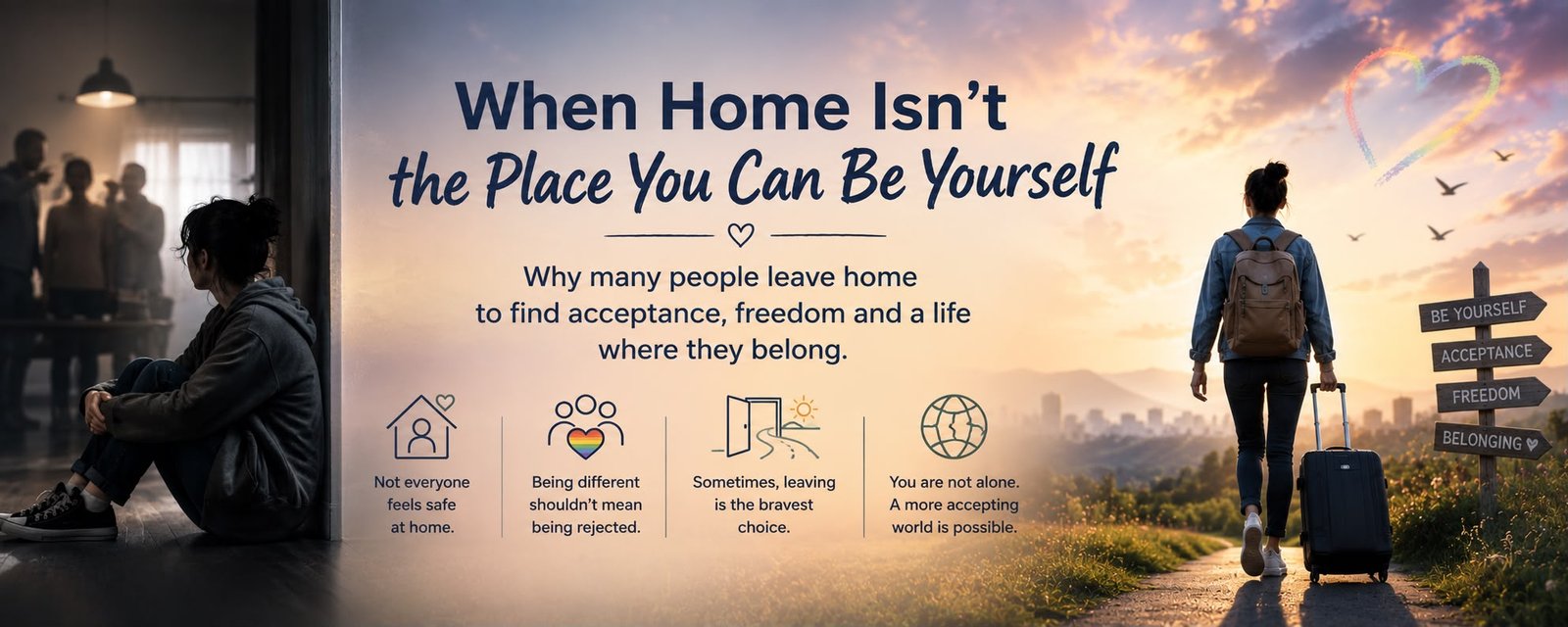
For many people, the hardest place to be themselves is not at work, at school or in society. It is at home.
Over the years I have spoken to countless people from especially the neurominority and LGBTQ+ communities. Those two communities are very interlinked, maybe because many of us have a more fluid way of thinking and experiencing all aspects of being human. Our backgrounds, identities and experiences are all wonderfully different of course, as human stories are.
Yet one theme appears again and again.
“I couldn’t be myself with my own family.”
Some describe spending years masking their neurology, carefully editing every word and behaviour to avoid criticism or rejection. Others describe hiding who they loved, terrified that honesty might cost them the people they loved most. Different journeys but very much the same fear.
Not everyone experiences this, of course. Many families are wonderfully accepting and inclusive from the beginning. But for those who are not, the emotional cost can be immense.
One of the saddest patterns I have noticed is how many of us eventually leave. We move to another city or another country and sometimes another continent. Not because we wanted to leave the family and home, but because it was easier to build a life somewhere we could simply exist without constantly explaining ourselves or hiding parts of who we were.
Imagine that for a moment.
Leaving your country is easier than being yourself around the people who raised you. That is an extraordinary price to pay.
This is not an easy subject to write about because there is often pain on every side. Parents may be grieving the future they imagined for their child. Families may be influenced by culture, religion, tradition or fear. They may genuinely believe they are protecting someone they love.
At the same time, the person who cannot be themselves carries a different pain, the loneliness of feeling unseen, misunderstood or only partially accepted.
Neither side usually wakes up wanting conflict. Most families are trying, in their own imperfect ways, to love one another. But perhaps one of the greatest misconceptions is that we have to fully understand someone before we can accept them. We don’t in my opinion.
None of us completely understands another person’s inner world, any other person’s inner world. We don’t know exactly what it feels like to experience life through someone else’s mind, body, senses or identity.
Acceptance does not require complete understanding, it simply requires us to recognise another person’s humanity and their right to be themselves. Ironically, it is often acceptance that creates the space for understanding to grow, not the other way around. When people feel safe, they explain and when they feel accepted, they open up and share. When they feel loved truly unconditionally, conversations become possible that would never happen in an atmosphere of judgement.
Perhaps our goal should not be to understand everything before we choose acceptance, perhaps our goal should simply be to love first. Love can sometimes become tangled with expectation.
“I love you… if…”
If you behave differently, think differently, hide that part of yourself…..if you become the person I hoped you would be or need you to be.
Yet love that depends upon someone becoming someone else is incredibly difficult to experience as love. Real belonging begins when we stop asking people to earn acceptance by becoming more like us.
Humanity has always been diverse. We have different minds, personalities, strengths and challenges. Different ways of experiencing the world and of loving.
These differences are not a weakness in humanity. They are one of its greatest strengths. They bring creativity, resilience, empathy, innovation, beauty and perspectives that none of us could create alone.
Families will not always agree about everything and they do not have to. Agreement is not the same as acceptance. We can hold different beliefs, different values and different perspectives while still recognising each other’s humanity, treating one another with dignity and making space for everyone to belong.
For many people, the greatest gift their family could ever give them is remarkably simple:
“You don’t have to pretend here.”
Imagine how many lives would change if every child, teenager and adult knew that home was the one place where they never had to wear a mask. Where they never had to edit themselves or had to choose between authenticity and belonging.
I think that giving people the freedom to be fully themselves is one of the greatest acts of love we can offer another human being.
Before you move on with your day, I would encourage you to pause for just a moment and ask yourself one question:
Is there someone in my own family who is still waiting for permission to be themselves?
If there is, perhaps today is the day to tell them something they may have needed to hear for years:
“You don’t have to pretend with me. You are loved unconditionally exactly as you are.”
Those few words may not erase years of hurt, but they might become the beginning of healing. And if enough families choose acceptance over expectation, perhaps fewer people will feel they have to leave home or even leave their country, to find somewhere they truly belong.
Because home should never be the place we feel least able to be ourselves. It should be the place where we feel safest to be who we truly are.